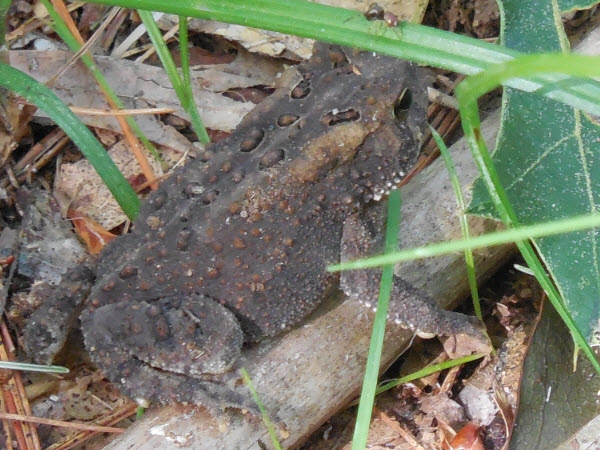
Frogs and Toads
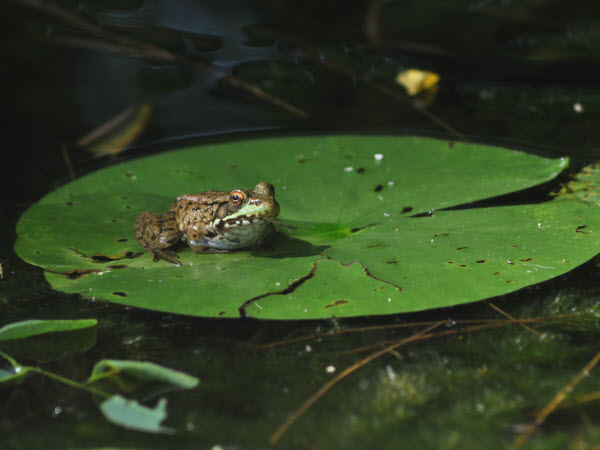
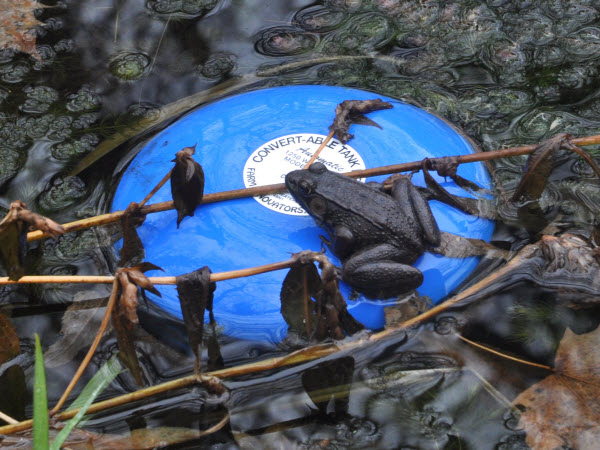
Frog on a Pond Heater
I searched for "frog on a lily pad" and got 8 million hits.
I searched for "frog on a pond heater" and got none.
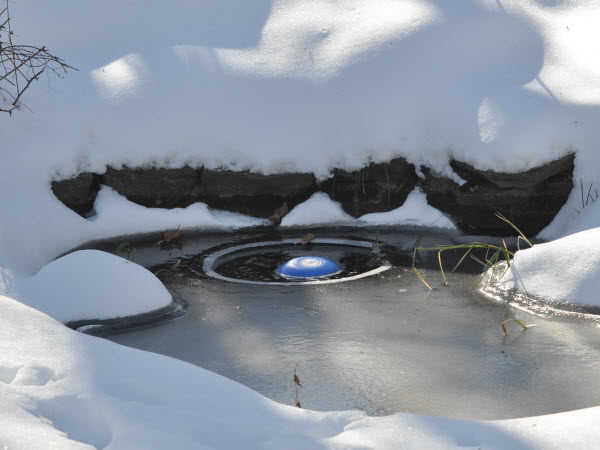
My wife spotted this frog staying warm on a December day, while we were doing some yard work. The pond was frozen over, and the pond heater floats in the water and maintains a small circle of no ice, needed to allow for escape of gases from the pond and perhaps some oxygenation. Without the heater, the frogs and fish that normally live through the winter (the pond is deep enough to not freeze through) can die, and our understanding is that buildup of certain gases is the problem. In any case, the opening in the ice is normally small, and cost to operate the heater is small.
We did get a good laugh to see the frog!
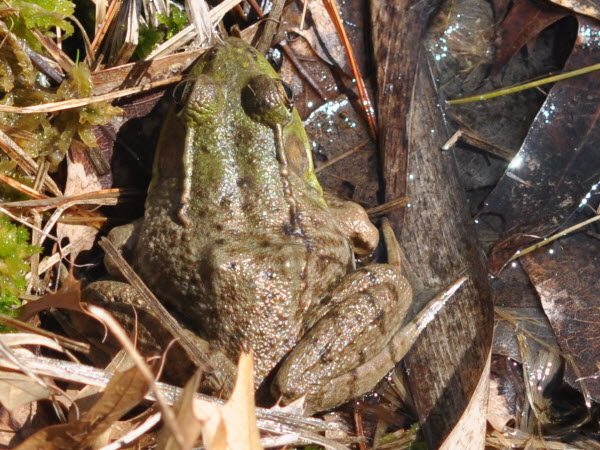
Bullfrog.
The bullfrog is very similar to the green frog, though significantly larger, and without the dorsolateral ridge of skin characteristic of the green frog, extending from the base of the eyes down the back.
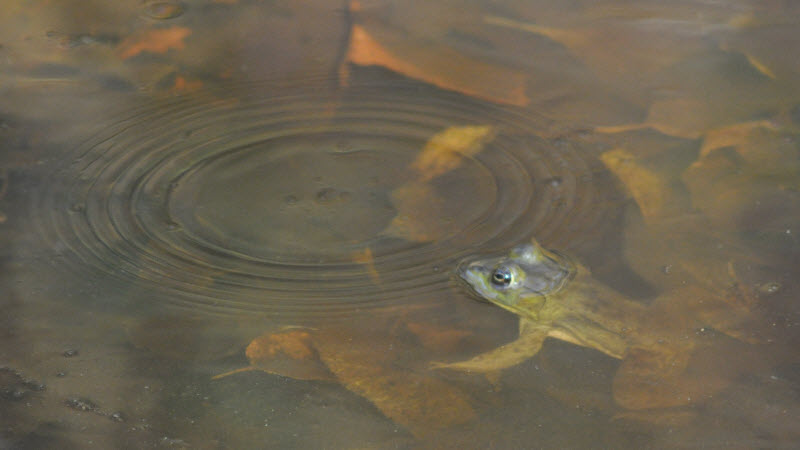
This particular frog was submerged in a swampy area, with only his eyes showing above the water. I was sitting on the shore, interested in the various birds and bugs in the area, and noticed that in this one area all of the bugs were consistently disappearing! I finally started watching - the bullfrog was so fast that I could never distinguish that there was even a frog present! I finally took several pictures of that area, through a telephoto lens. It was only after I got home and displayed the image at full resolution that I saw the frog! In this image there is a second frog to the left, and in the full image there are at least a couple of more frogs visible.
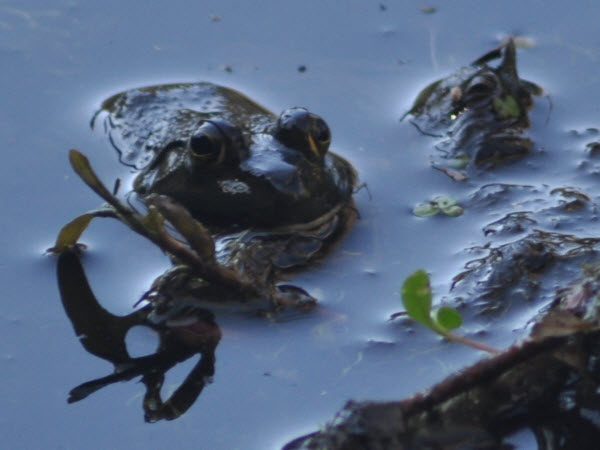
Bull frog or Green frog? I took this to be a bullfrog, based on its size! But maybe it is a green frog - how to tell? I did some searching, and find these distinguishing characteristics:
- Song - the two frogs have very different songs - I found a good description and recording at Willys Wilderness, describing the bull frog as a deeply pitched song, and the green frog as having a single note sounding like a pluck of a banjo
- Size - the bullfrog is larger - maybe the size of a hand, while the green frog is more the size of the fingers.
- Dorsolateral fold - the green frog has a dorsolateral fold, the bullfrog does not.
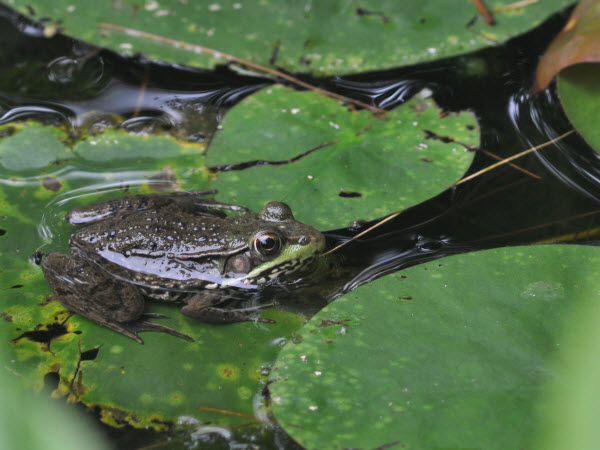
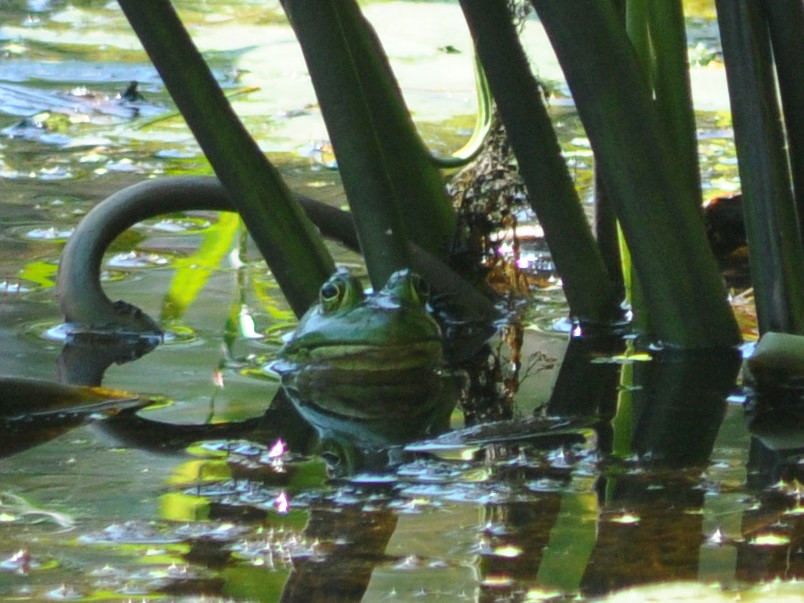
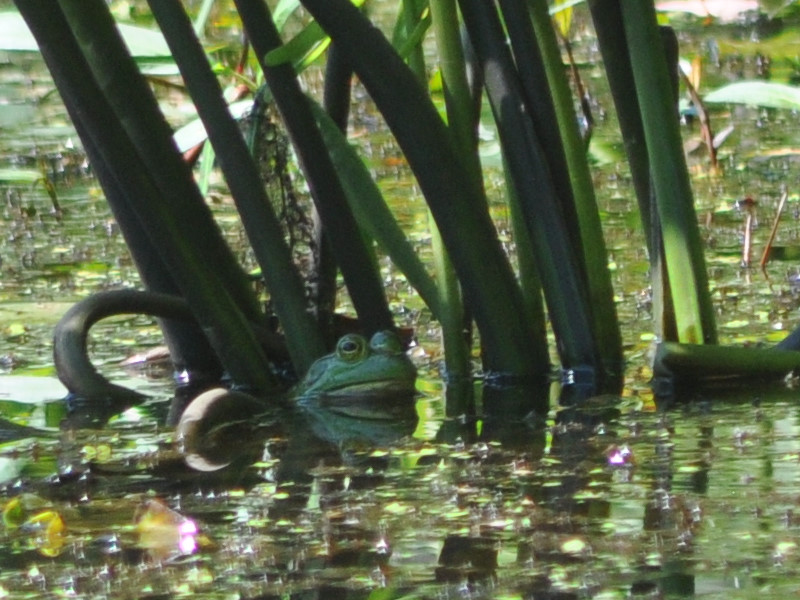
So what is this frog? I did not hear its song. It looks big, but I don't know if it is the size of my hand. And I could not see whether a dorsolateral fold was present or not. I like the one picture because I can see the eyes of the frog better, and the other because the tympanum is clearly visible. But no view of the back, and so no view of the absence or presence of the dorsolateral fold.
Green Frog
This Green Frog was conveniently living in the water garden in our back yard.
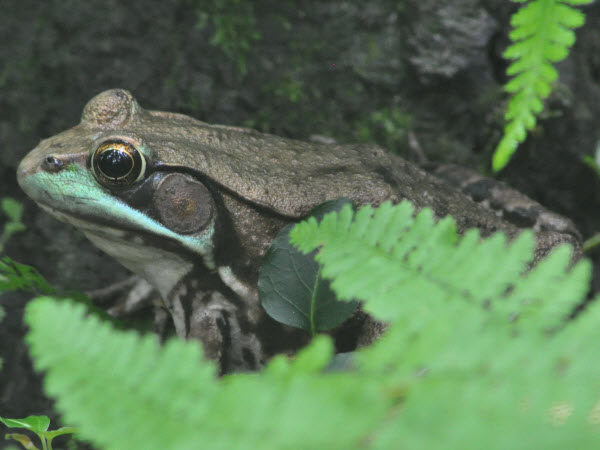
Tympanum. I was so surprised by the perfectly round, and quite large, disk behind the eye of this frog. On reading, I learned that this is the ear - essentially the ear drum, the tympanum, which is stretched across a ring of cartilage, with a rod that connects and transmits sound to the inner ear fluid. The tympanum serves to protect the middle and inner ears from water and debris, and allows the frog to hear both above and below water.
There is more - see the reference http://frogsaregreen.org/tag/how-frogs-hear: frogs have a closed air loop - an internal pressure system that keeps their own ear drum from vibrating excessively from their own call. Pressure builds between their lungs and ear drum, which then equalizes the pressure between the inner and outer surfaces of the ear drum, which cuts down on sound vibrations.
Also ref: https://naturallycuriouswithmaryholland.wordpress.com/2013/08/15/a-frogs-tympanum/
and this very nice ref: HiltonPond.org - Green Frogs
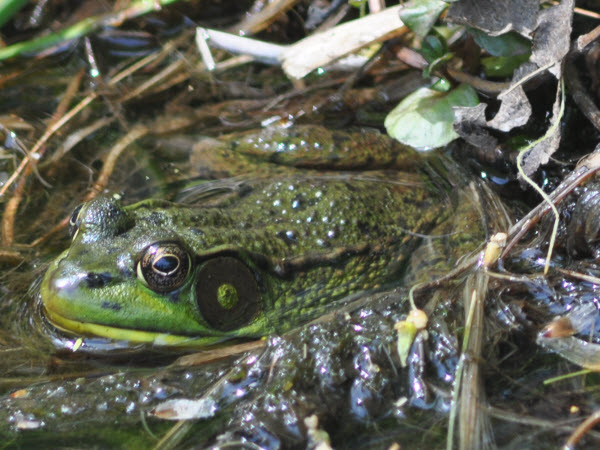
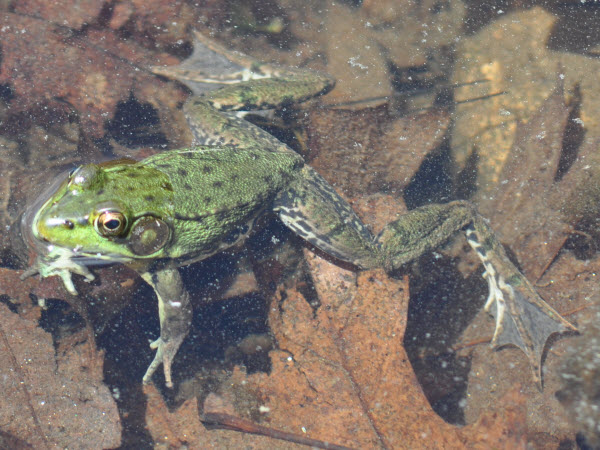
Two frogs together - a female and male? The tympanium in the male is said to be considerably larger than the eye, while in the female the tympanium is about the same size as the eye.
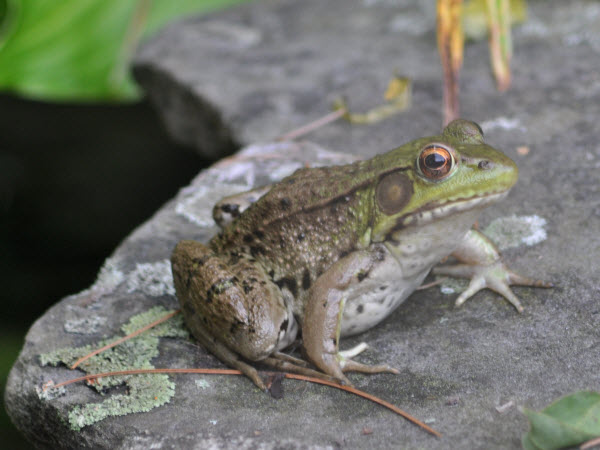
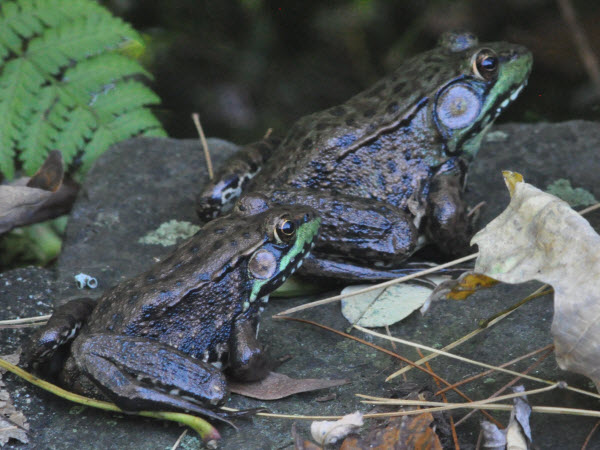
The dorsolateral ridge, characteristic of the green frog, is very apparent in this photo, extending from the base of the eyes down the back. The ridge is apparent also in each of the green frog images above, and is absent in the topmost image of a bullfrog.
This frog was some distance from a stream, sitting near a tree. This sun was just coming up in the morning, and not very bright yet. The green lips of this frog were almost iridescent, and very strikingly green. The color is strong in the photo, though not as striking as it was to me when I first saw the frog. I thought the green was unusual - until I looked back through my other frog pictures - they all have green lips. But the overall body color of most of my other frog pictures is also green, or even brown, and I think it is the color of this frog that seemed to emphasize the striking green lips.
I did get a chuckle when searching the Internet for green frog lips, to find this advertisement:


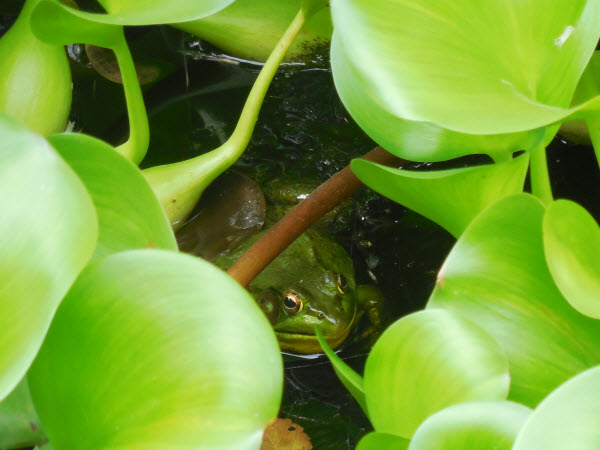
The photo to the left shows a large growth of the green leaves of a floating water plant - I was not sure why I took the picture, until I found the frog, well hidden. Look closely to see the large tympanum, so a male frog.
Wood Frogs
On an early spring day I saw a pond, still about one third covered by ice and some distance away. And a lot of noise - I recorded with my camera:
I would have been pleased to hear the sound of peepers ushering in a new spring, but this was not peepers. In fact, it sounded more like ducks, and I could not even place the sound to the pond - it could have been from the trees or anywhere around.
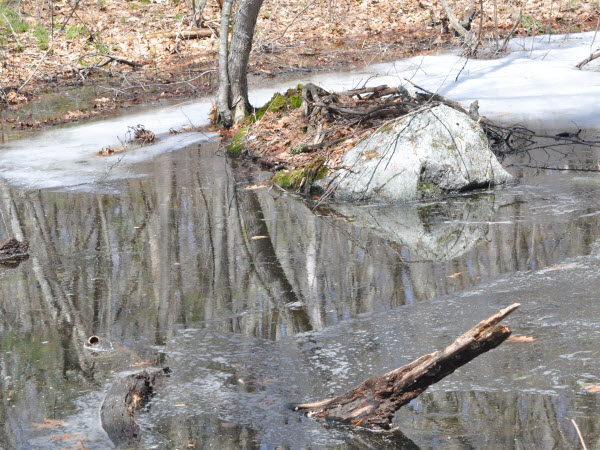
I hiked over to try to see and hear better, and noticed that the water of the pond was in turmoil - constant thrashing, and a lot of noise. I took quite a few pictures, trying to capture the sense of the turbulence - that was not so successful, but the next image could contain two or three beings contributing to the disturbance of the water.
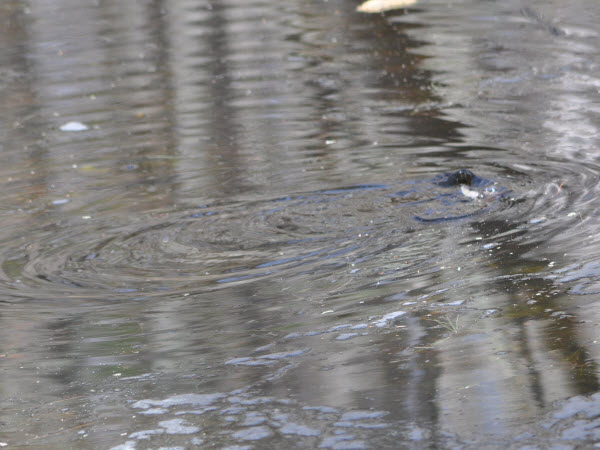
The answer was frogs! No idea how many - and I have never seen this level of activity before, or since (I did return the next week). And now, when I go back to listen to the recording, it is much more clearly the sound of frogs.
I found a good description, reference below, and listing a few points of interest to me:
- The wood frog is brown, reddish brown or copper colored, with a white belly. A distinguishing feature is a brown mask that stretches across its eyes.
- Dorosolateral fold characteristic of frogs is present.
- If you are not accustomed to hearing it, it sounds like quacking ducks - so I am not the only person who confused the sound of the frogs with ducks!
- Wood frogs are at home on dry land.Their athletic trunk and powerful hind legs enable them to hunt flies, crickets, beetles and other insects in upland forests through the summer and early fall. But, like all amphibians, wood frogs must return to water to breed and lay eggs.
- Because vernal ponds typically dry up over the summer, fish do not live in them. Wood frogs evolved the use of these temporary pools to minimize the types of predators that could eat their offspring.
Also this reference: http://blog.nwf.org/2016/04/frogs-that-thrive-and-dive-in-vernal-pools/
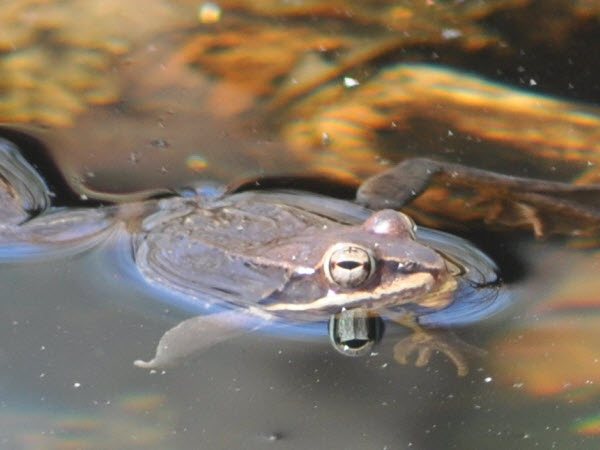
In most of my photos of turbulent areas the frog in the water was hard to make out - too deep in the water and too much activity. But I did get a number like the one here.
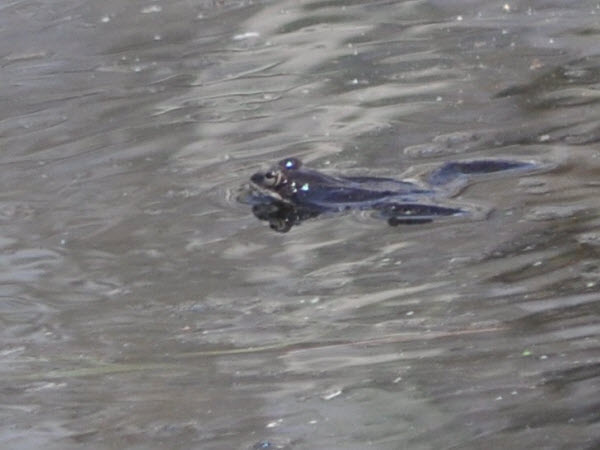
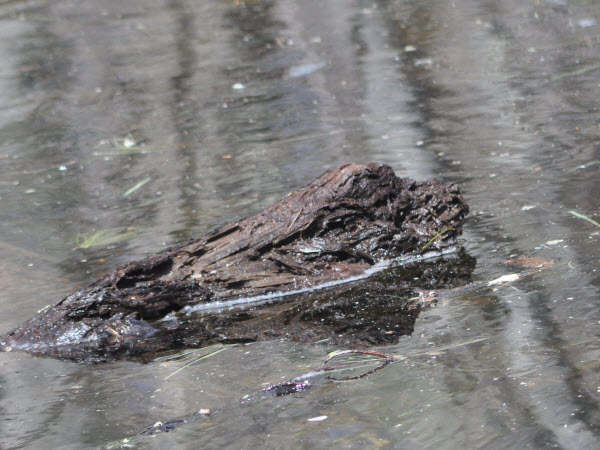
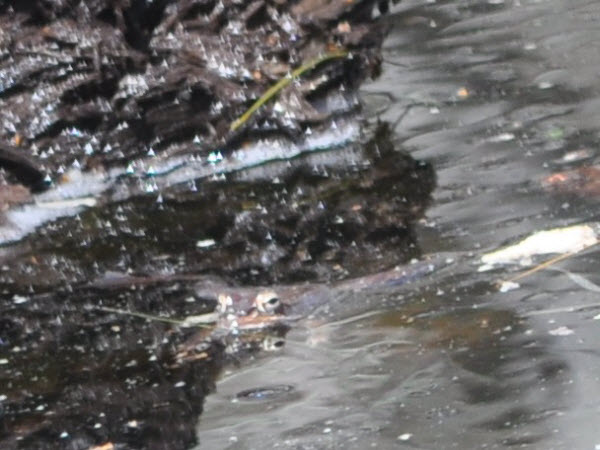
I always enjoy seeing how well a frog can hide in its surroundings - here an old log, and below a detail showing the frog.